
AI and Me
How much is me, how much is A.I

Anyone else noticed that AI has a negative spin on it at the moment?
Students booed at the University of Arizona while Google CEO, Eric Schmidt at the University spoke positively about AI. Some christians have desperately let the world know that involvement with AI is the beast from Revelation, literally suggesting that your salvation is not safe if you are involved in AI.
Do I use AI for my writing? Do I use AI in my sermons? Do I use AI to write songs? Am I flirting with the beast?
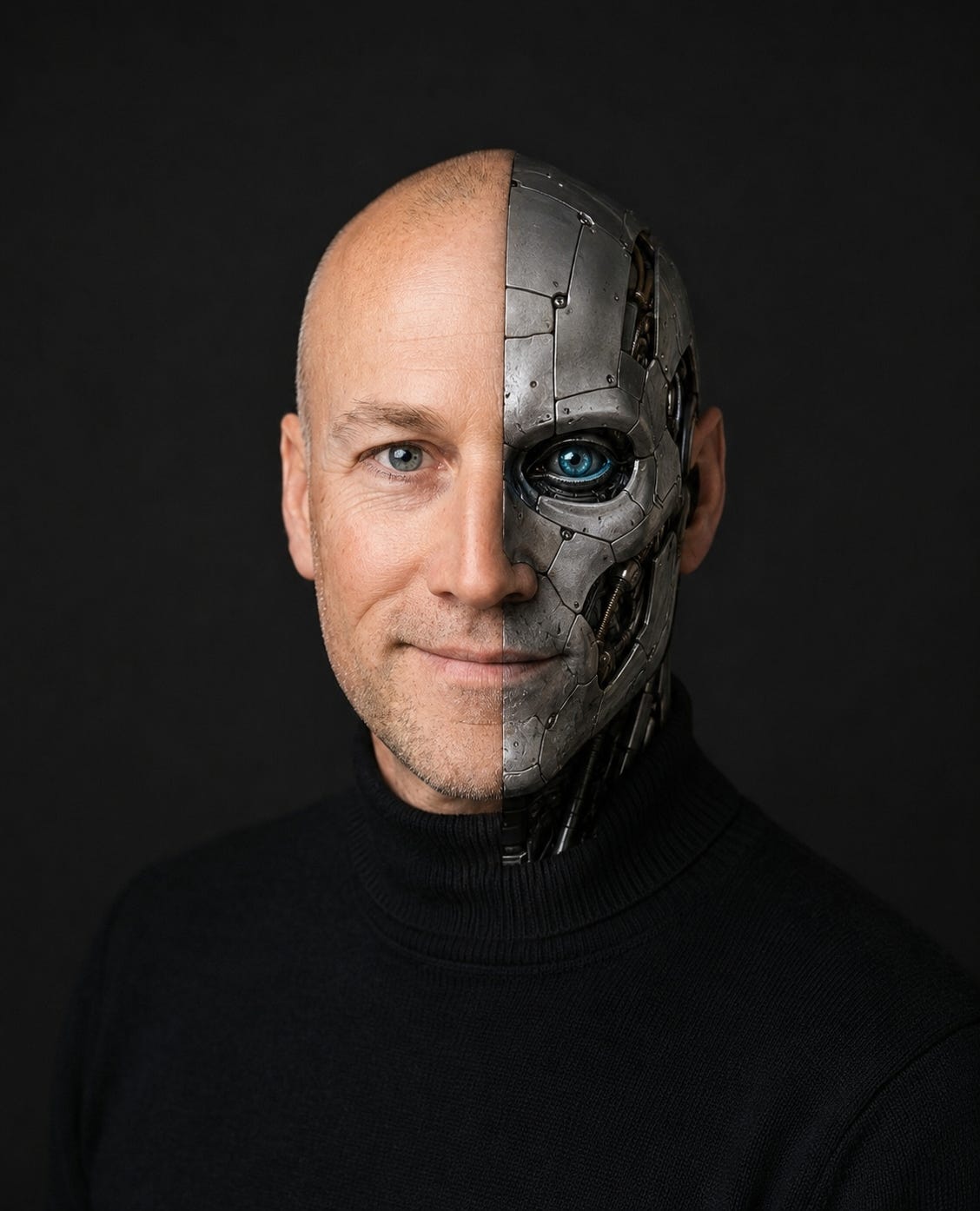
Here is the role AI currently plays in my life.
First, my writing. I am constantly jotting down thoughts to return to later: a concept, an idea, an observation, or quite often, a moment of frustration at something profoundly stupid.
Here’s one straight out of my notes folder last week.
I have a growing concern that charisma has outweighed scholarship. Christian leaders seem to string together eloquent phrases like “the rooms you gather in determine the destiny you walk in” whilst a loving congregation nods in agreement having disposed of their capacity for intellectual reasoning. If one were to stop for just a moment and consider how dangerous this statement truly is they would surely recoil at the phrase and gasp. Our destiny is only sealed by the Holy Spirit.
Okay, so this idea isn’t fully formed.
I may then decide that the thought is worth developing into a Substack article. My first step is often to ask ChatGPT to rewrite it. My ideas can arrive clunky, rigid and unfinished, while AI helps smooth the language and make the thought clearer and more palatable without changing what I am trying to say.
Here’s the same thought again but this time I’ve asked AI to help me communicate it:
I have a growing concern that charisma has begun to outweigh scholarship. Christian leaders seem able to string together eloquent phrases such as, “The rooms you gather in determine the destiny you walk in,” while a trusting congregation nods in agreement, having quietly surrendered its responsibility to think critically. Yet if we were to pause for even a moment and consider what such a statement actually implies, we should recoil at its danger. Our destiny is not determined by the rooms we enter, the people we know or the circles that welcome us. It is sealed by the Holy Spirit.
I have no issue copying and pasting that wording directly into my article. It is still what I am trying to say. They are my thoughts, my journey, my expression, my feelings and my heart, simply cleaned up, made clearer, nicely cemented in the final line and prepared for public consumption.
So YES I use AI to help me write my substacks - but is it AI?
Quiz time, which of these thoughts belongs to AI?
“Preaching the gospel without signs and wonders is like describing a meal to someone who is starving.”
“Preaching the gospel without signs and wonders is like describing a feast to someone who is starving.”
The answer of course is both thoughts belong to me, pulled from my notes folder in 2016, the second was the result of running it through ChatGPT, it changed the word to feast, which is stronger because it helps convey the desperation and the fullness of whats being offered, it holds the concept and makes it hit better, I’d probably use it.
So does this mean I have somehow received the mark of the beast? Or does it simply mean that, much like the arrival of spellcheck and grammar correction, I now have the freedom to let my thoughts flow without constantly getting bogged down in finding the perfect way to phrase every sentence? Instead of wrestling with wording, I can focus on the substance of what I want to say. Which is what I would call “brilliant” for someone who has dyslexia like me. If using AI to express my thoughts somehow compromises my humanity, then surely Stephen Hawking’s speech synthesizer did the same. Of course it didn’t. It simply gave voice to thoughts that were already his.
So, with that cleared up, do I use AI to write my sermons?
No. Never.
I never read a sermon. I preach from bullet points, in my own voice, from what I have studied, wrestled with and become convinced of.
Do I, however, build extensive research projects within ChatGPT containing hundreds of files? Absolutely. My own notes, theological books I have converted to searchable PDFs, commentaries, journal articles and years of accumulated study. I use AI to analyse them, challenge them and compare them against Scripture in the pursuit of what I believe is faithful, biblically sound teaching.
Do I ask it to critique every sermon I preach?
Yes.
Do I ask for the harshest feedback it can give?
Yes.
Has it made me a better preacher?
I hope so.
It regularly identifies weaknesses in my arguments, unclear transitions, assumptions I have left unexplained and places where I have overstated a point (or not centered on Christ as much as I can). It is often more willing to expose flaws in my teaching than even a close friend would be, not because it is wiser, but because it has no fear of offending me.
What about music?
AI has been a complete game changer for someone like me.
I still write the songs. The melody. The lyrics. The ideas. But now I can run them through an AI music platform and, within minutes, hear them performed by a full band in a professionally produced arrangement.
Why does that matter?
Because there is a huge difference between the song in your imagination and the song that actually exists.
We’ve all (well the composers) written something we thought was incredible, only to hear it back and realize it wasn’t nearly as good as we imagined. AI strips away that illusion. Sometimes it confirms you’ve written something genuinely strong. Other times it exposes weaknesses you never noticed. Ironically, the better the production, the more obvious the flaws in the songwriting become.
I rarely write a song now without immediately running it through AI. Not because I want AI to write my music, but because I want it to reveal whether the music I’ve written is actually worth listening to.
For me, it has become the musical equivalent of looking in a mirror. It doesn’t create my ideas; it simply reflects them back with a level of clarity I could never achieve in my own head.
So to finish, I just ran this article I’ve written through A.I and asked it to give me a closing thought… as if it could think, here’s what A.I “thinks” verbatim…
Every generation has wrestled with new tools. The printing press was feared. Calculators were accused of destroying mathematics. Spellcheck was said to weaken literacy. Search engines were going to make us stop remembering anything. Yet none of those things were inherently good or evil. They simply amplified the person using them.
Here’s how I would close, not re-written by AI at all, 100% my words:
So in answer to my own question—AI is an excellent tool in the same way money is, to one person it can finance drugs to another finance blessing. A.I can lead to evil or good. But the bigger question some of you are really asking is this, why rant about this today? Well I write music, run it through AI and release it, some platforms are now denying that music, even articles written on this platform, (Substack) will soon be marked as “AI”. In fact, I just ran this paragraph through an “A.I Checker” and guess what... marked 95% AI with only a 5% chance that a human wrote it, it was also marked as containing plagiarism. (I wrote it, didn’t even use a spell checker!)
Rant over.
Closing thought - AI is brilliant :-)
We know it can never replace: your responsibility to think, discern and follow Christ.